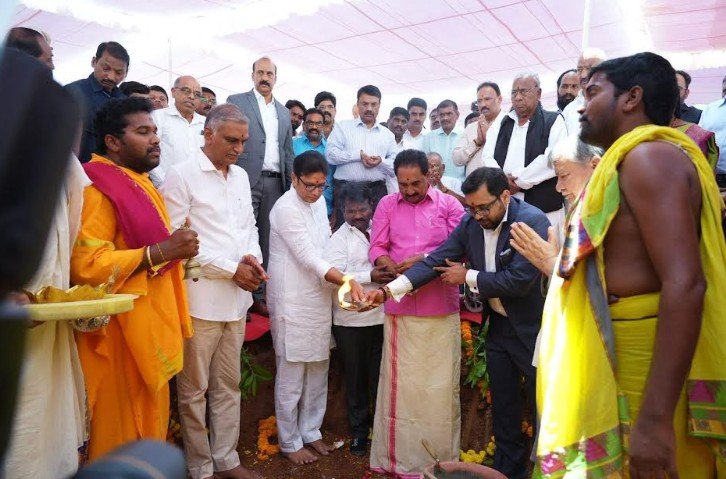
Juno Joule Bio Fuels Private Limited, a leading player in India’s emerging bio-energy sector, announced the groundbreaking of its flagship Compressed Bio-Gas (CBG) project at Narmetta Industrial Area in Siddipet district, Telangana. The project marks a significant step in advancing sustainable waste-to-energy solutions and strengthening India’s clean fuel ecosystem.
The initiative is part of a larger cluster development comprising 10 CBG plants, each with a capacity of 10 Tons Per Day (TPD), aggregating to a total production capacity of 100 TPD, with a total planned investment of INR 700 crore. The first phase, being launched at Narmetta, comprises three CBG units (10 TPD each) with an investment of INR 210 crore, and is envisioned as a key hub for scalable bio-energy production in the state.
The project will be implemented in three phases – Phase 1 (3 plants), Phase 2 (3 plants), and Phase 3 (4 plants) – with the entire cluster expected to be completed by 2029–2030, contributing to India’s transition toward circular and low-carbon energy systems.
The groundbreaking ceremony was attended by prominent dignitaries, including Shri Duddilla Sridhar Babu, Minister for IT, Electronics & Communications, Industry & Commerce and Legislative Affairs, Government of Telangana, and Shri Bhubaneswar Kalita, Member of Parliament, Rajya Sabha and Chairman of the Parliamentary Standing Committee on Science & Technology, Environment, Forests and Climate Change.
Senior representatives from Bhagyanagar Gas Limited (BGL), industry stakeholders, and government officials were also present, underscoring the strategic importance of the project.
The project is being implemented under the Government of India’s CBG–CGD Synchronisation Scheme, which aims to integrate compressed bio-gas into the City Gas Distribution (CGD) network. By enabling the supply of domestically produced, renewable gas into existing infrastructure, the initiative aligns with national priorities under Atmanirbhar Bharat and programmes such as GOBARdhan, reducing reliance on imports while strengthening long-term energy security.
Juno Joule’s CBG plants will convert agricultural residue such as paddy straw, along with organic waste streams including poultry waste and cattle dung, into clean fuel. This approach not only addresses environmental concerns such as stubble burning and greenhouse gas emissions but also promotes a circular economy by transforming waste into valuable energy resources.
Speaking at the occasion honourable Minister Shri Duddilla Sridhar Babu said, “Mr. Nagasarath Rayapati came to us with a clear vision to build a meaningful clean energy initiative. We felt that this vision should not be limited to Hyderabad, but should extend across the state and beyond. I am happy to say that he has received strong support from the Government of Telangana in taking this forward. Through his commitment, understanding of the sector, and ability to bring together the right stakeholders, he has successfully initiated this project under Juno Joule Bio Fuels. Today, while many are talking about the potential of clean energy, what we need is more such execution-driven efforts on the ground. Initiatives like this contribute not just to industrial growth, but also to rural development—‘gramam abhivrudhi’, which ultimately leads to ‘desham abhivrudhi’. India still depends significantly on imports for its energy needs, and projects like this help us move closer to self-reliance. This initiative will also support domestic production of biofuels, contributing to programmes such as Make in India and Make in Telangana. I wholeheartedly welcome this effort and appreciate Mr. Rayapati’s leadership in bringing this vision to life.”
The project has secured structured offtake arrangements with GAIL (India) Limited and Bhagyanagar Gas Limited (BGL), ensuring integration into the CGD network and enabling supply for mobility and industrial applications in the Hyderabad region. These partnerships provide demand assurance and strengthen the commercial viability of the project.
India’s Compressed Bio-Gas (CBG) sector is entering a high-growth phase, shifting from voluntary adoption to a mandatory blending framework, 1% in CNG/PNG, rising to 5% by 2028–29. Backed by the SATAT initiative, this is driving capacity expansion toward 15,000 TPD, aimed at reducing gas imports, strengthening energy security, and supporting rural incomes. In this context, scalable, integrated models such as cluster-based CBG projects are critical to ensuring reliable supply and seamless integration into the CGD network.
Beyond its environmental benefits, the initiative is expected to generate significant socio-economic impact. By creating local employment opportunities and establishing reliable feedstock supply chains, the project will enhance farmer incomes and contribute to rural development in Telangana.
Mr. Nagasharath Rayapati, CEO of Juno Joule Green Energy Private Limited Bio Fuels Private Limited, said, “We are pleased to mark the commencement of this project, which represents an important step toward building India’s next phase of clean, self-reliant energy. As the country moves toward mandatory CBG blending and reduced import dependence, scalable and reliable bio-energy infrastructure becomes critical. Our cluster-based approach is designed to deliver consistency at scale, unlock value from agricultural waste, and contribute meaningfully to India’s energy security and rural economy.”
India’s bio-energy sector is witnessing increasing momentum, driven by policy support and the need for sustainable alternatives to fossil fuels. However, large-scale implementation requires reliable feedstock supply, infrastructure integration, and viable offtake mechanisms. Juno Joule’s cluster-based approach addresses these challenges by enabling scale, efficiency, and consistent supply, positioning the project as a replicable model for future development.
The Narmetta facility marks the beginning of a broader vision to build integrated bio-energy infrastructure across key regions, aligned with national initiatives such as the GOBARdhan scheme and India’s clean energy transition goals.
This groundbreaking ceremony represents not only the launch of a project but the foundation of a scalable, future-ready model for sustainable energy production, rural economic growth, and reduced carbon emissions.