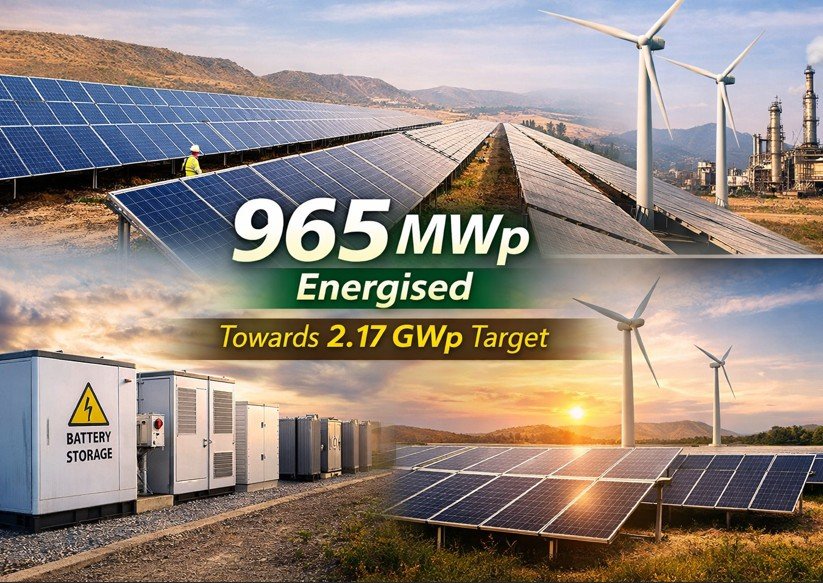
KPI Green Energy Limited has announced that it has successfully energised 965 MWp of capacity under its Independent Power Producer (IPP) portfolio, marking a significant milestone in its renewable energy expansion strategy.
The latest achievement includes the addition of 376 MWp capacity, comprising solar and wind projects across multiple developments tied to Gujarat Urja Vikas Nigam Limited. This brings the company closer to its total planned IPP portfolio of 2.17 GWp, with the remaining capacity currently under execution and expected to be commissioned in phases.
A key highlight includes the commissioning of a 200 MW (240 MWp) solar project at Khavda Solar Park, one of the early operational projects within the large-scale solar park developed by GSECL. The company has also made notable progress in hybrid renewable projects, including a 92 MWp hybrid project combining solar and wind capacity, which was commissioned ahead of schedule.
In its larger portfolio, KPI Green is executing a 620 MW renewable capacity comprising both solar and hybrid projects under long-term power purchase agreements with GUVNL. A significant portion of this capacity has already been energised, with full commissioning targeted by October 2026.
Additionally, the company has secured a 150 MW wind project, which has achieved financial closure and is expected to be commissioned by October 2027.
Expanding beyond generation, KPI Green has also entered the energy storage segment through its subsidiary, Sun Drops Energia Limited. The company has signed an agreement for a 445 MW / 890 MWh standalone Battery Energy Storage System (BESS), marking its entry into utility-scale storage solutions.
The company stated that its growing portfolio of long-term contracted projects, many under 25-year power purchase agreements, is expected to ensure stable and sustainable revenue streams while strengthening its position as a leading IPP in India.
Backed by its parent KP Group, KPI Green continues to expand across solar, wind, hybrid, and energy storage segments, contributing to India’s clean energy transition and long-term sustainability goals.