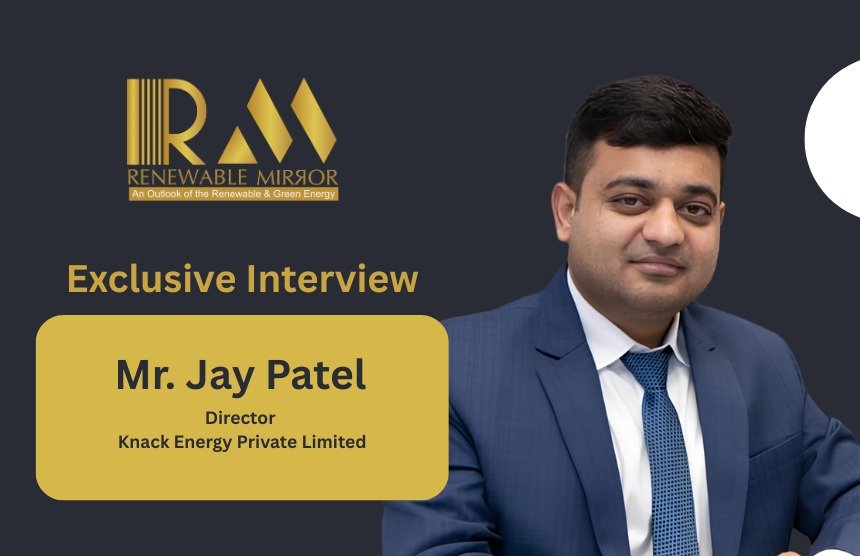
“At Knack Energy, our vision goes beyond manufacturing. We are building consistently reliable solar solutions through smart production, advanced technology, and a deep understanding of real field conditions.”
Knack Energy showcased high-efficiency TOPCon modules at Intersolar Expo 2025. What unique features of these modules drew attention from professionals and EPC contractors?
At Intersolar Expo, our Solar PV N-Type TOPCon modules stood out because they combine high conversion efficiency with real-world reliability. These modules are engineered for better performance even under low-light and high-temperature conditions, which is a critical requirement for solar projects in India and similar climates.
Industry professionals also appreciated the fully automated manufacturing process with minimal human intervention, which ensures consistent quality and reduces variability across large volumes. This resonates especially with EPC contractors, as it enhances predictability and reduces risk in large solar installations.
You announced plans to expand capacity from 800 MW to 2 GW by September 2025. What challenges do you anticipate in scaling up production, and how are you preparing to overcome them?
Scaling up production rapidly brings both supplychain and quality assurance challenges. When increasing from 800 MW to 2 GW within a short timeframe, ensuring material availability, process stability, and consistent output quality is essential. To address this, we are investing in smart manufacturing ecosystems that include digital traceability layers (MES + SAP S/4 HANA) across production. This allows us to monitor process parameters, detect anomalies early, and maintain quality across batches even at high throughput. We are also strengthening supplier partnerships and inventory planning to avoid bottlenecks.
Your manufacturing facilities emphasize minimal human intervention, energy efficiency, and waste reduction. How do these practices impact overall product quality and operational efficiency?
Automation and smart manufacturing are at the core of our approach. By reducing manual steps, we achieve uniform process control, fewer defects, and less variation between modules. For example, inline digital inspection and real-time traceability help catch process deviations immediately, rather than waiting for final tests.
Energy efficiency and waste reduction practices improve operational throughput, lower costs, and also demonstrate environmental responsibility, an increasingly important factor for investors and long-term customers.
Knack Energy runs training programs with local institutes on solar cell fabrication and module testing. How are these initiatives shaping the talent pipeline for the solar industry?
Our training programs are more than community support they build industry-ready skills where they matter most. We partner with technical institutes to train students on solar cell fabrication basics, module assembly, testing protocols, and quality checkpoints.
This means when trained graduates enter our facilities, they add value quickly, understand quality expectations, and reduce the time needed for hands-on supervision. Over time, this creates a skilled talent pipeline, reducing dependency on external hiring and strengthening local ecosystems.
With plans to explore markets in Southeast Asia, the Middle East, and Africa, what strategies is Knack Energy employing to enter and compete in these regions?
Our strategy centres on product relevance and reliability. Knack Energy’s modules, designed for performance under challenging conditions such as high heat and dust, are naturally suited for many markets in Southeast Asia, the Middle East, and Africa.
In addition, we focus on market-specific compliance and certifications, building distribution partnerships, and offering strong post-sales support. By ensuring our products meet both performance and regulatory expectations in those regions, we aim to compete effectively with global brands.
As an active member of SESI and ISMA, what policies or industry initiatives do you believe are critical to support domestic solar manufacturing and grid modernization?
We strongly support policies that provide long-term clarity and investment stability. Programs like the MNRE’s Approved List of Models and Manufacturers (ALMM) help domestic manufacturers compete against imports and gain access to government projects. Knack Energy’s inclusion in ALMM underscores our commitment to quality and compliance.
Additionally, incentives for technology adoption (e.g., TOPCon, automation), storage integration mandates, and grid modernization initiatives will be critical to increase domestic manufacturing scale and strengthen grid resilience.
During Intersolar, you discussed energy storage, grid integration, and future solar technologies. Which emerging trends or technologies do you see having the biggest impact in the next 3–5 years?
Three trends stand out:
- High-efficiency modules (especially TOPCon and beyond), which improve energy yield and project economics.
- Digital manufacturing and quality assurance tools, such as AI-driven defect detection and smart traceability, will become standard for Tier-1 quality assurance.
- Solar-plus-storage systems paired with digital energy management, enabling solar to become dispatchable and grid-friendly, rather than purely intermittent.
Together, these trends will redefine how solar assets are designed, operated, and financed in the next few years.