




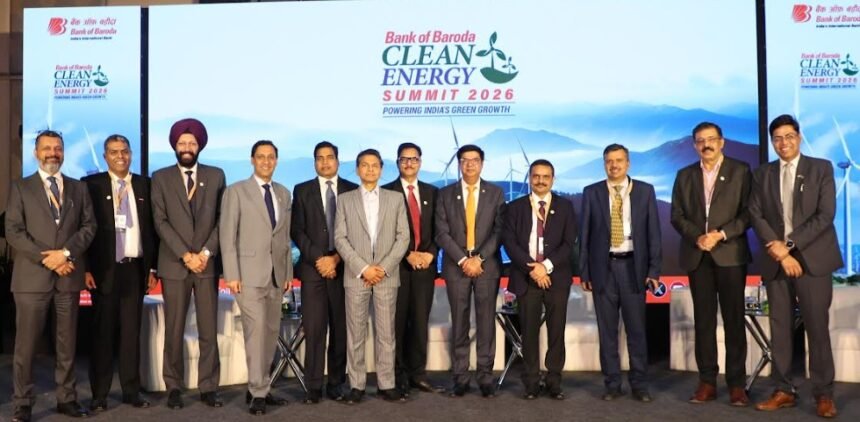
Indian Bank and Bank of Baroda participated in the Clean Energy Summit 2026 held in Mumbai, bringing together key stakeholders from India’s renewable energy ecosystem to deliberate on the future of sustainable energy and green finance. The summit provided a platform to discuss policy measures, financing strategies, and innovative ideas to accelerate India’s progress toward its 2030 renewable energy targets.
Held under the theme “Powering India’s Green Growth,” the flagship conference witnessed participation from more than 125 representatives, including renewable energy developers, corporates, global and domestic investors, rating agencies, financial institutions, and policy experts. Against the backdrop of India’s continued progress toward its long-term climate commitments and energy security goals, discussions focused on scalable, reliable, and future-ready renewable energy solutions. Key topics included growth opportunities, innovation, risk management, and capital mobilization across the renewable energy sector.
Speaking at the summit, Dr. Debdutt Chand, Managing Director & Chief Executive Officer, Bank of Baroda, said, “India’s clean energy transition is one of the most significant investment opportunities of this decade. Bank of Baroda is proud to play a catalytic role by aligning capital flows with climate responsibility. Achieving India’s renewable energy ambitions will require large-scale capital mobilization, innovative financial structures, and close collaboration between policymakers, developers, and financial institutions to ensure sustainable and financially sound development. Our focus is on building a robust green financial ecosystem that fosters innovation while maintaining strong risk discipline.”
Mr. Lalit Tyagi, Executive Director, Bank of Baroda, added, “Renewable energy is no longer an alternative—it has become the cornerstone of India’s economic and environmental future. Long-term and sustainable financing will be critical as we move toward the goal of a ‘Developed India’. Bank of Baroda remains committed to supporting solar, wind, hydro, nuclear, hybrid, and 24/7 renewable projects to translate India’s green ambitions into reliable and scalable realities.”
Panel discussions at the summit focused on scaling renewable energy capacity and financing the energy transition. In a session titled “Building Scalable, Reliable, and Future-Ready Renewable Companies and Platforms,” industry leaders from Adani Green Energy, JSW Energy, Tata Power Renewable Energy, CleanMax Enviro Energy Solutions, and Hinduja Renewables Energy discussed the shift from megawatt-scale projects to gigawatt-scale platforms, evolving revenue models beyond traditional power purchase agreements (PPAs), and the integration of storage and hybrid technologies. The panel also examined execution risks, balance-sheet management, governance practices, and preparedness for emerging segments such as green hydrogen, offshore wind, and floating solar.
CARE Ratings presented a sector outlook highlighting capacity addition trends, capital requirements, and key risk factors shaping India’s renewable energy landscape.
Another panel, “Financing the Green Transition: Opportunities, Risks, and Innovation in Green Banking,” featured senior representatives from NABFID, IIFCL, India InfraDebt, MUFG, and CareEdge Ratings. Discussions covered evolving credit standards, offtake risk assessment, payment security mechanisms, long-term debt structuring, refinancing strategies, and the growing role of green bonds and blended finance in supporting India’s clean energy transition.