




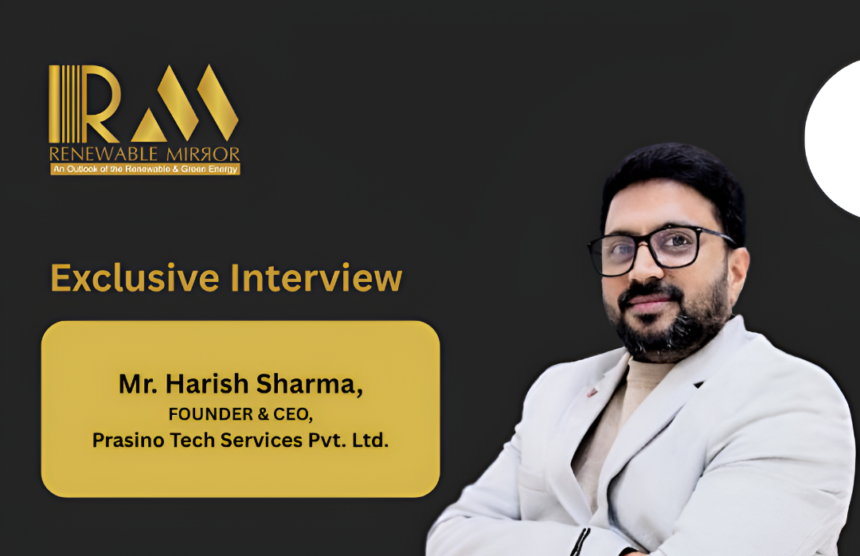
“India’s clean energy transition will succeed not just on capacity addition, but on engineering integrity, safety, and long-term performance. At Prasino Tech, our role is to ensure renewable assets are built right, perform as intended, and remain bankable throughout their lifecycle.”
How does the company differentiate itself and establish a competitive advantage in the renewable energy and sustainability consulting sector?
Prasino Tech positions itself as a pure technical advisory and Independent Engineering (IE) firm, with a clear focus on design engineering, design validation, and risk mitigation. We also instrumental in the research and development of new and emerging technologies on the design and implementation part. Our competitive advantage lies in our ability to provide technically sound, execution-ready, and lender-compliant solutions across the renewable energy value chain. Unlike generic technical consultants, we operate with deep engineering ownership, supporting developers, investors, and lenders through design preparation and reviews, DPRs, TEVs, and specialized engineering services such as BIPV, RIPV, and even DPRs of manufacturing units. We provide forensic technical assessments i.e. an independent, evidence-based engineering investigation undertaken to identify the root cause of technical failures, safety incidents, or performance underachievement in renewable and industrial assets, and to recommend corrective and preventive actions that protect long-term performance, safety, and bankability.
In what manner does your company approach the full spectrum of renewable energy solutions, from solar and wind to hybrid systems and BESS projects?
Our approach is rooted in system-level engineering. We support projects from concept and feasibility to detailed design, validation, and construction oversight. This includes utility-scale solar and wind, hybrid projects, and increasingly, BIPV and BESS-integrated solutions aimed at improving dispatchability and grid reliability. Acting as Owner’s Engineer or Lender’s Engineer, we ensure technical consistency, regulatory compliance, and performance assurance across all project stages. We are working on futuristic RIPV and BIPV.
Which cutting-edge methodologies or digital innovations make your services truly stand out in today’s market?
We are using advanced energy modelling and analytical tools to enhance project bankability and performance certainty. Data backed simulations, detailed loss analysis, and sensitivity assessments form the backbone of our renewable advisory services. For hybrid and storage-backed projects, we apply integrated modelling frameworks to assess energy dispatch behaviour and degradation impacts. Our Industrial Services vertical uses datadriven power quality analysis, energy auditing, fire safety audits, and root cause analysis to strengthen asset reliability and operational safety.
What metrics or frameworks does the company use to quantify its role in advancing client sustainability initiatives?
Our impact is measured through technical performance, risk reduction, and optimized design metrics. These include optimized energy yield, minimized system losses, improved power quality indices, enhanced safety compliance, reduced operational downtime, and material optimization during construction (e.g., 10-20% reduction in concrete/steel usage via precise foundation sizing and layout efficiency). Through engineering-led sustainability, we help clients achieve measurable efficiency gains, cost savings in CAPEX, and longterm asset value, rather than short-term compliance outcomes.
How do partnerships with EPC firms, policymakers, and global sustainability initiatives factor into your overall growth strategy, and how do they help drive innovation and market expansion?
While maintaining strict technical independence, we collaborate closely with EPC contractors to ensure constructability and execution alignment. Engagement with policymakers and industry bodies helps us stay aligned with evolving codes, standards, and grid requirements. Our experience across international markets, Middle East and Africa, enables us to deliver globally benchmarked engineering solutions adapted to local regulatory and operating conditions.
Which emerging trends in renewable energy and sustainability consulting do you anticipate will have the biggest impact on your company’s strategy and growth in the upcoming years?
Hybrid renewable projects, energy storage integration, RIPV and grid-centric performance evaluation will significantly influence the sector. There is also a growing focus on power quality, safety audits, and lifecycle performance assurance. As project sizes increase and financing structures evolve, the demand for independent engineering, design validation, and forensic technical services will continue to grow.
In the context of India’s journey toward net-zero, how is your company shaping the energy transition, and what pioneering strategies or solutions are you deploying to accelerate this shift?
I personally believe that India’s net zero journey must advance the wider SDG agenda, not climate alone. Prasino Tech therefore designs its clean energy work to deliver both decarbonization and broader development outcomes. By improving the reliability bankability, and performance of solar, wind, hybrid, and BESS projects, we directly support SDG 7 (Affordable and Clean Energy) and SDG 9 (Industry, Innovation and Infrastructure) through better engineered, grid ready, and cost efficient assets. Our RIPV solutions, energy and safety audits, and optimization of industrial energy use further advance SDG 12 (Responsible Consumption and Production) by reducing resource intensity and operational wastage.
A strong focus on safety, engineering discipline, and quality execution promotes SDG 8 (Decent Work and Economic Growth), creating safer worksites and higher skill green jobs. Through rooftop, RIPV, and grid conscious planning that minimizes land impacts and enhances resilience, we contribute to SDG 11 (Sustainable Cities and Communities) and SDG 13 (Climate Action).
Finally, by working closely with OEMs, EPCs, lenders, and local partners to standardize good practices, Prasino Tech strengthens ecosystems and capacity building aligned with SDG 17 (Partnerships for the Goals). In short, our role in India’s energy transition is to ensure that every renewable project we touch is not only net zero aligned but also maximizes co benefits across priority SDGs by not only reducing emissions but also enhancing livelihoods, infrastructure quality, and environmental stewardship.