



Wood Mackenzie’s Global Solar Inverter Manufacturer Rankings for H1 2025 identified Huawei and Sungrow as the top two solar inverter manufacturers globally, according to the firm’s latest assessment of the sector.
The ranking evaluates leading inverter manufacturers using a weighted framework that considers factors such as shipment scale, financial strength, ESG performance, R&D investment, supply-chain resilience and after-sales service. Wood Mackenzie stated that the companies assessed collectively represent nearly 90% of global solar inverter shipments.
Huawei and Sungrow continued to lead the global inverter market in H1 2025, reflecting their strong international presence, diversified product portfolios and established manufacturing and service capabilities. Wood Mackenzie highlighted that competition among leading suppliers remains intense as customers increasingly prioritise reliability, service support and sustainability credentials.
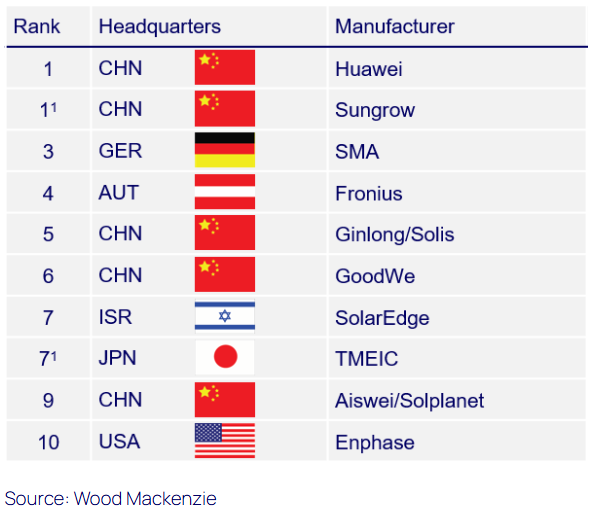
Solis and Solplanet Feature in the Ranking Chart
Alongside the market leaders, Solis and Solplanet also featured in the Wood Mackenzie ranking chart for H1 2025, indicating their participation among the globally assessed inverter manufacturers.
While Wood Mackenzie did not disclose individual ranking positions or scores beyond the top performers, the chart reflects a broad group of manufacturers competing in the global solar inverter market, highlighting increasing diversity beyond the top two suppliers.
According to the report, the top 10 inverter manufacturers together account for over 70% of global market share, underscoring a concentrated yet competitive industry landscape. As solar deployment scales worldwide, differentiation among inverter suppliers is increasingly driven by service capability, ESG performance and long-term operational reliability.
“The 2025 global inverter landscape is led by a diverse group of power-electronics leaders combining scale with innovation,” said Timothy Shen, Senior Research Analyst at Wood Mackenzie. “Increasingly, competitive advantage is defined not just by shipment volume, but by capabilities across pioneering Environmental, Social, and Governance (ESG) initiatives, service quality and stable supply chains.”
“The strongest performers are those leveraging regionalised assembly strategies,” Shen commented. “This strategic positioning allows manufacturers to comply with local content requirements and navigate import barriers while maintaining their supply reliability.”