



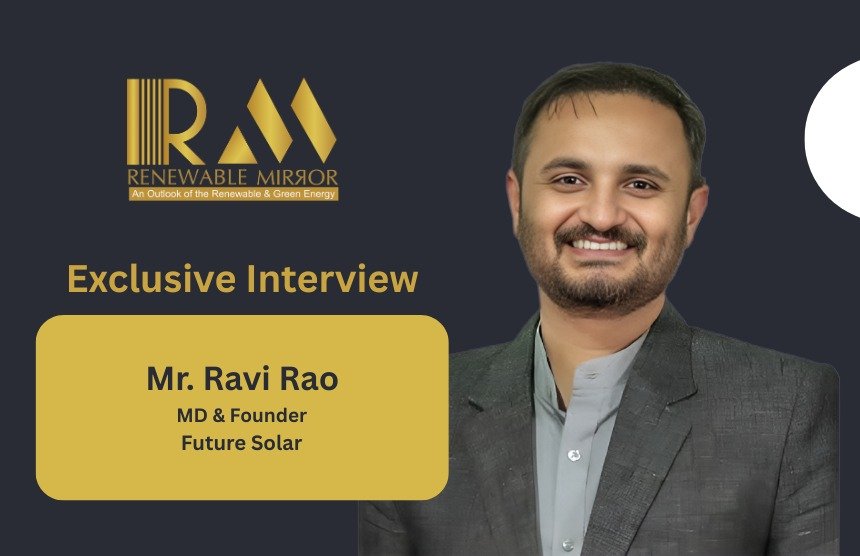
“The company’s main focus has been on research and development to deliver the latest technology and latest products to its customers. That’s why we started with Topcon and are focusing only on Topcon glass-to-glass modules. The customer is the key to any business. We are glad to have customers who are solar installers, EPC players, or IPP players who are aware of sustainability and the greener tomorrow.”
Future Solar has made remarkable strides in solar manufacturing. Now, how has the company evolved in terms of technology, capacity, and market presence over the years?
Future Solar’s vision and mission from day one has been the latest technology-driven model manufacturing company. So the company has focused from day one on the latest technology which has been Topcon glass-to-glass modules. Higher efficiency, higher throughput, higher reliability. So it’s been two years the company is into the manufacturing business, and from day one, it has focused on Topcon modules, and it’s one of the few companies to introduce Topcon high-efficiency modules in this country.
How is Future Solar integrating technology to enhance precision, efficiency, and long-term reliability?
So the company has built a world-class state-ofthe-art plant at Karjan Vadodara. The plant has a manufacturing capability of 5 gigawatts per year. All the machines, all the utilities have been designed and established in a way that it has turned out to be one of the finest facilities in this country. Whatever the raw material that has been used to manufacture the modules are from the tier one suppliers.
The team that is monitoring the manufacturing process is highly experienced professionals who have been doing this for 20 to 25 years of their professional career. The machines that are making the modules are the finest state-of-the-art facilities. The technical, highly experienced skilled people and the raw material that is being used are from tier one suppliers. The ultimate finished product is always the tier one modules, basically.
Could you share the strategic intent behind this expansion and its significance for India’s renewable energy landscape?
So the government’s directive and government’s intentions are very clear to develop the entire ecosystem from polysilicon to the modules, basically. And as part of that, we started with modules, reached at a scale of 5 gigawatt, which is a very decent scale. Now, the next plans are further backward integration from modules to cell, then to wafer, then to ingot, and hopefully in coming years to polysilicon. So the company plans to have 5 gigawatt of manufacturing capability across the entire value chain.
Our 2 gigawatt cell plant construction has already started and is expected to be commissioned in 2026. Another 3 gigawatt cell plant construction will be starting soon. So 5 gigawatt of Topcon cell, G12R cell manufacturing will be operational by early 2027. Once that is done, then we will start work on wafer and ingot. The whole idea is to reduce dependency on other countries and have a self-reliant ecosystem.
How does Future Solar ensure consistency, compliance, and customer confidence as it continues to grow?
The organization is very clear to deliver world-class products locally manufactured.For that, we have built a fantastic state-of-theart, fully automated, AI-enabled 5 gigawatt manufacturing facility at Vadodara Karjan. To make sure the product is of the finest quality, we source our raw materials from tier one vendors.
To ensure that the entire manufacturing process is carried out very well, we have highly skilled technical professionals at the plant who make sure that each and every module manufactured at Future Solar comes with the best quality, high efficiency, and high throughput.
What key initiatives or practices has Future Solar implemented to minimize its environmental footprint?
Future Solar’s creation is done to reduce the carbon footprint, basically, to contribute towards a sustainable tomorrow. The idea is doing this at gigawatt scale in a short span and going backward integrated. We are putting all efforts that contribute towards a sustainable tomorrow.
The renewable energy market in India is evolving rapidly. What differentiates Future Solar in such a competitive space, both in technology and in the relationships built with clients?
The company’s main focus has been on research and development to deliver the latest technology and latest products to its customers. That’s why we started with Topcon and are focusing only on Topcon glass-to-glass modules. Customer is the key for any business. We are glad to have customers who are solar installers, EPC players, or IPP players who are aware about sustainability and the greener tomorrow.
We want maximum people to visit the plant, understand the facility, understand the raw materials being utilized, understand the process, understand the quality parameters, andmeet and interact with our experienced technical professionals. That has been the core idea—to spread awareness and deliver the latest technology products to maximum people in the country.
Looking ahead, what is the longterm vision for Future Solar?
The company is already into module manufacturing, and cell manufacturing is under construction. After that, we will go for wafer and ingot. So 5 gigawatt of entire value chain— from module to ingot—is what we are trying to achieve in the next 2–3 years.Simultaneously, we would also like to contribute on the BESS, battery energy storage system front.
India has set an ambitious target of 1,800 gigawatt of non-fossil fuel energy by 2047. Future Solar plans to contribute as much as possible in the next 20 years by building the entire value chain from ingot to modules, and going forward into battery energy storage systems andother renewable energy verticals.
Looking forward to your visit at the plant. Thank you.