



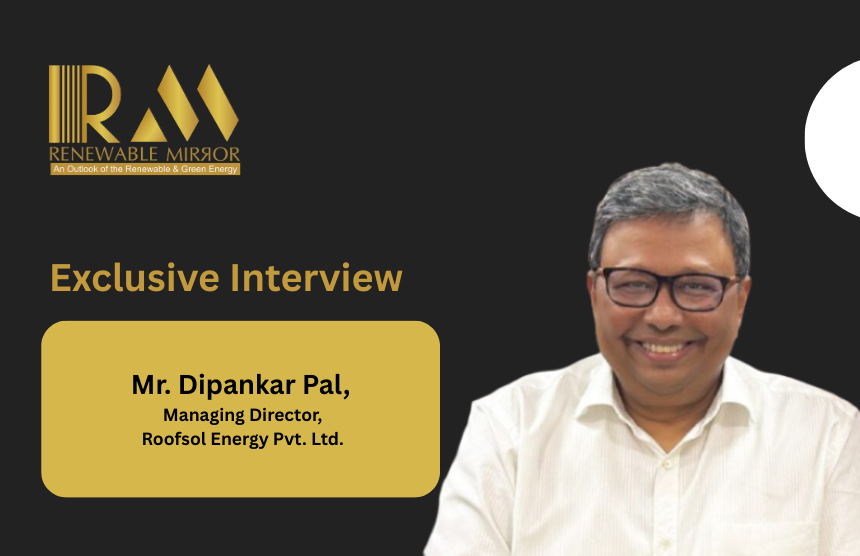
“At Roofsol Energy, execution excellence is driven by a process-led approach backed by experienced teams. Every project begins with a detailed engineering assessment, design validation, and risk mapping before mobilization. We follow standardized SOPs for safety, quality checks, and commissioning, irrespective of project size or location.”
Roofsol Energy has established itself as a strong player in India’s rooftop solar EPC space, particularly in the commercial and industrial segment. What factors have been most critical in building this position, and how do you see the rooftop solar market evolving over the next few years?
Roofsol’s growth in the C&I rooftop solar EPC space has been driven by three core factors: engineering depth, execution reliability, and customer-centric structuring. From the outset, we focused on understanding industrial energy behavior rather than offering generic solar solutions. This allowed us to deliver systems that are optimized for load profiles, roof conditions, and long-term operational performance.
Equally important has been our ability to scale execution across multiple states while maintaining consistent quality standards. Strong vendor partnerships, standardized design frameworks, and experienced on-ground teams have helped us build trust with marquee industrial clients.
Looking ahead, the rooftop solar market will evolve beyond simple cost savings. We see increasing emphasis on energy security, decarbonization commitments, OPEX/RESCO models, and asset performance guarantees. Rooftop solar will become a strategic energy infrastructure for businesses, not just an add-on.
As a company offering end-to-end EPC solutions, from design and engineering to commissioning, how does Roofsol Energy ensure execution quality, safety, and timely delivery across diverse project types and geographies?
At Roofsol Energy, execution excellence is driven by a process-led approach backed by experienced teams. Every project begins with a detailed engineering assessment, design validation, and risk mapping before mobilization. We follow standardized SOPs for safety, quality checks, and commissioning, irrespective of project size or location.
Our centralized project governance ensures realtime monitoring of milestones, while regionally deployed execution teams enable faster response and adaptability to local site conditions. Safety is non-negotiable, our teams are trained on stringent EHS protocols, and compliance audits are embedded at every stage.
This balance of centralized oversight and decentralized execution allows us to deliver projects on time, safely, and to the expected performance benchmarks.
CRISIL–Bridge to India has ranked Roofsol Energy among the top players in India’s rooftop solar market. How significant is this recognition for the company?
This recognition is extremely significant for us because CRISIL–Bridge to India is one of the most respected and data-driven authorities in India’s renewable energy sector. Being ranked No. 1 as a Project Developer and No. 2 as an EPC contractor reflects not just capacity numbers, but our consistent execution capability, project quality, and long-term customer trust across India.
Roofsol Energy works across both CAPEX and OPEX business models. How do customers typically decide between these two approaches, and how has demand for OPEX/longterm PPA models changed in the C&I segment?
Customer choice between CAPEX and OPEX typically depends on financial strategy, risk appetite, and longterm sustainability goals. CAPEX interest organizations looking for asset ownership and higher long-term returns, while OPEX remains attractive for to companies seeking zero upfront investment and predictable energy costs.
Over the past few years, demand for OPEX and long-term PPA models has accelerated significantly in the C&I segment, driven by rising grid tariffs, ESG commitments, and the need for energy price certainty. This shift is also reflected in Roofsol’s growing OPEX portfolio, we have signed PPAs aggregating approximately 120 MWp, of which over 50 MWp has already been executed, and we are targeting a commission of 100 MWP by FY 2025-26.
This evolution underscores how OPEX module is increasingly being viewed not merely as an alternative financing structure, but as a strategic energy solution for businesses. As a result, many organizations are choosing to deploy capital toward core operations while partnering with brands such as Roofsol Energy for their energy needs.
With asset performance becoming increasingly important for project owners, how is Roofsol Energy strengthening its O&M capabilities to ensure long-term plant efficiency, uptime, and returns?
As solar assets mature, O&M quality becomes critical to protecting returns. Roofsol Energy has significantly strengthened its O&M capabilities by combining experienced field teams with advanced monitoring and datadriven performance analysis.
We focus on preventive maintenance, real-time fault detection, and performance benchmarking to ensure high plant availability and generation consistency. Our approach goes beyond routine maintenance, we actively work on generation optimization, degradation control, and rapid resolution of downtime issues.
For customers, this translates into reliable energy output, predictable savings, and confidence in longterm asset performance.
Through Roofsol Homes, the company has entered the residential rooftop solar segment. What are the key differences in execution, customer engagement, and scale when comparing residential projects with commercial and industrial installations?
Residential solar differs significantly from commercial and industrial projects in terms of scale, customer engagement, and decision-making dynamics. While C&I installations are largely driven by technical evaluations and financial metrics, residential adoption is deeply influenced by trust, clarity, and confidence in the brand.
Through Roofsol Homes, we have built a customercentric B2C model that combines robust EPC capabilities with strong marketing and transparent brand communication. Clear messaging around savings, subsidies, system performance, and aftersales support plays a crucial role in simplifying solar adoption for homeowners. Our digital outreach, on-ground engagement, and educational content help address common concerns and build trust well before installation begins.
Operationally, residential projects require highvolume execution with consistent quality and faster turnaround times. By integrating structured processes, trained installation teams, and proactive customer communication, we ensure a seamless experience from enquiry to commissioning.
While the engagement models differ, our core engineering standards, safety protocols, and commitment to long-term performance remain consistent across both residential and small commercial enabling Roofsol Homes to scale responsibly while strengthening customer confidence.
As module technologies, inverters, and monitoring systems continue to evolve, how does Roofsol Energy evaluate and adopt new technologies while balancing performance, reliability, and cost for customers?
Technology adoption at Roofsol Energy is guided by performance validation and lifecycle value, not hype. We continuously evaluate advancements in modules, inverters, and monitoring platforms through simulations, pilot projects, and supplier assessments.
Our priority is to deploy technologies that deliver measurable gains in efficiency, safety, and reliability while remaining commercially viable for customers. Bankability, service support, and long-term performance data are key decision factors. This disciplined approach allows us to future-proof projects without compromising on cost-effectiveness or operational stability.
What are the most important trends shaping India’s solar and rooftop energy market today, and how is Roofsol Energy positioning itself to capitalise on these opportunities?
India’s solar market is being shaped by a combination of policy support, evolving business models, and rising consumer awareness. One of the most significant drivers today is residential rooftop solar, accelerated by government initiatives such as the PM Surya Ghar: Muft Bijli Yojana, which is catalyzing large-scale adoption by making rooftop solar more affordable and accessible for households.
In parallel, the C&I segment is witnessing strong momentum toward OPEX and long-term PPA models, driven by rising grid tariffs, ESG commitments, and the need for predictable energy costs. Technology advancements in modules, inverters, and digital monitoring are further enhancing performance and reliability expectations.
Roofsol Energy is positioning itself at the convergence of these trends by scaling its C&I OPEX portfolio, expanding its residential footprint through Roofsol Homes, and strengthening O&M and performance management capabilities, enabling customers to derive long-term value from their solar investments.